
Industry Background: PET Sheet Extrusion and Material Handling Challenges
PET sheet extrusion is widely used in food packaging, thermoforming, and industrial applications.
Compared with injection molding, PET sheet extrusion lines typically operate continuously, with high and stable material consumption, often exceeding hundreds of kilograms per hour per line.
For PET processors, material stability, clean handling, and uninterrupted feeding are critical to maintaining sheet transparency, thickness consistency, and overall production efficiency.
This case study introduces how a central feeding system supports reliable, high-output PET sheet extrusion production.
Customer Profile: PET Sheet Extrusion Manufacturer
The customer operates a large-scale PET sheet extrusion plant producing PET sheets for downstream thermoforming applications.
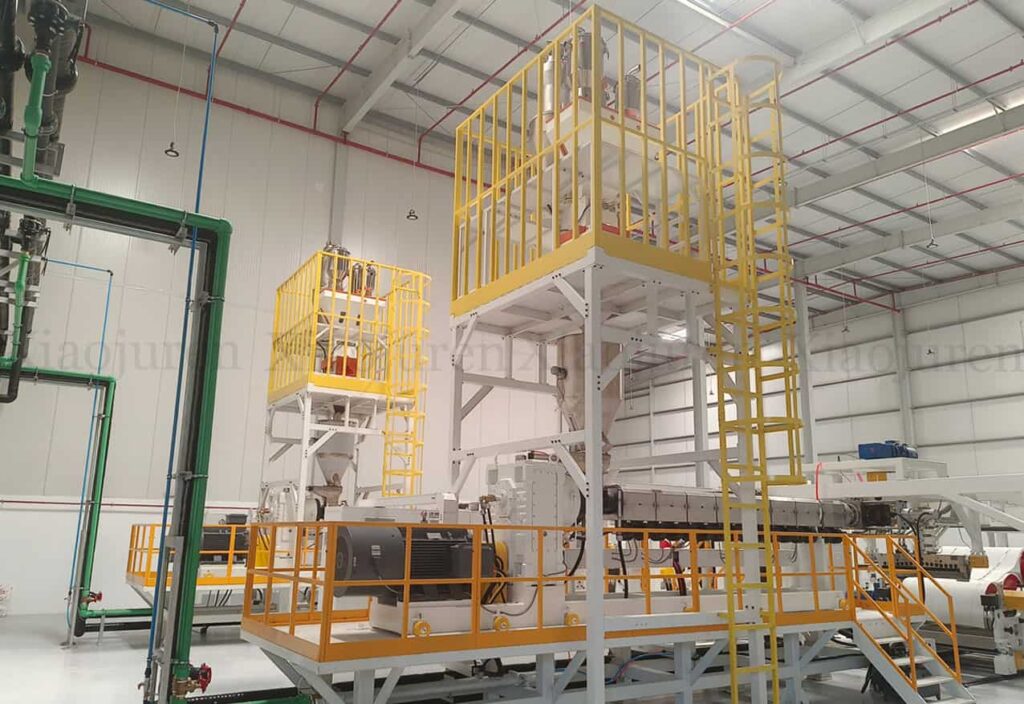
Production characteristics:
- Continuous PET sheet extrusion
- High hourly material consumption
- Use of virgin PET resin and PET regrind
- Strict requirements for material cleanliness and ratio control
As production capacity increased, the customer realized that traditional material handling methods were no longer sufficient.
The customer operates a large-scale PET sheet extrusion plant producing PET sheets for downstream thermoforming applications.
Production characteristics:
- Continuous PET sheet extrusion
- High hourly material consumption
- Use of virgin PET resin and PET regrind
- Strict requirements for material cleanliness and ratio control
As production capacity increased, the customer realized that traditional material handling methods were no longer sufficient.
Before installing the central feeding system, the plant faced several operational issues common in PET extrusion workshops:
1. Feeding Interruptions
Manual loading struggled to keep up with continuous extrusion demand, especially during peak production hours.
2. High Labor Dependency
Operators spent significant time transporting, opening, and refilling PET material bags.
3. Workshop Cleanliness Issues
Handling PET regrind manually caused dust accumulation and material spillage, affecting workshop organization.
4. Inconsistent Material Supply
Fluctuations in feeding rhythm increased the risk of sheet quality variation.
These challenges directly impacted productivity and operating costs.
Solution Overview: Central Feeding System for PET Sheet Extrusion
To solve these issues, the customer implemented a central feeding system specifically designed for PET sheet extrusion lines.
System configuration:
- Centralized material storage for virgin PET resin and PET regrind
- Vacuum conveying system for continuous material transport
- Gravimetric blending units to ensure stable material ratios
- Automated feeding to multiple PET extrusion lines
This solution centralized material handling while ensuring accurate and uninterrupted feeding.
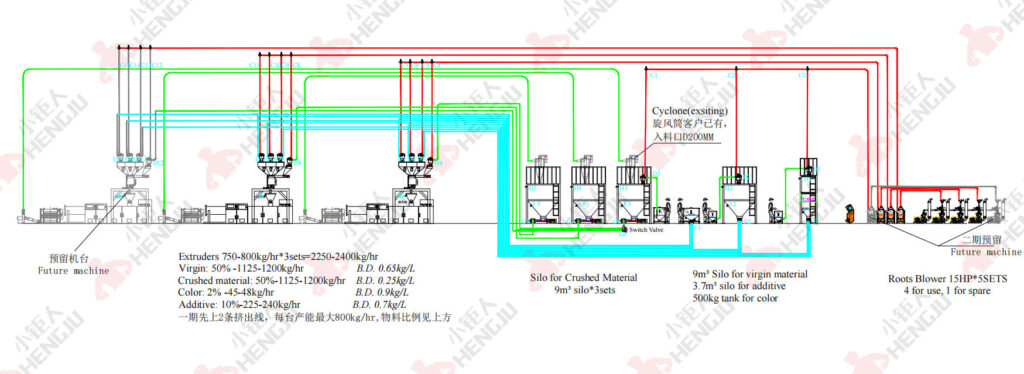
Material Flow Design: From Storage to Extrusion Lines
The system follows a streamlined material flow:
- PET virgin resin and PET regrind are stored centrally, reducing scattered material handling.
- Materials are automatically conveyed through sealed pipelines to the blending units.
- Gravimetric blenders maintain precise material ratios for consistent sheet properties.
- Blended material is continuously supplied to each PET sheet extrusion line.
This design ensures stable feeding, clean handling, and continuous operation.
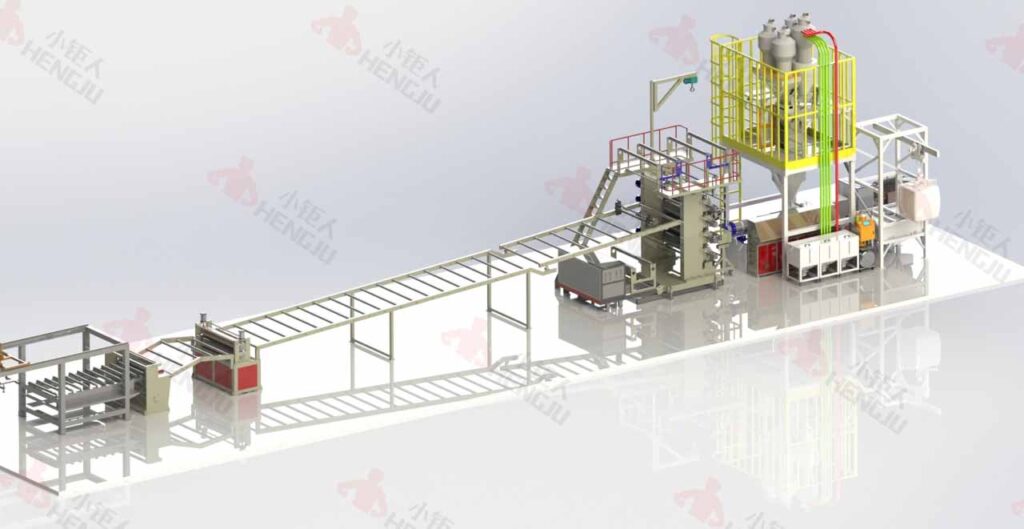
Results After Central Feeding System Installation
After the system was commissioned, the customer observed clear improvements:
✔ Stable, Continuous Feeding
PET sheet extrusion lines operated without feeding interruptions, even during long production cycles.
✔ Reduced Labor Costs
Manual material handling was largely eliminated, allowing operators to focus on production monitoring.
✔ Cleaner Workshop Environment
Enclosed conveying and centralized storage significantly reduced dust and material loss.
✔ Improved Sheet Quality Consistency
Stable material supply and accurate blending helped maintain uniform thickness and transparency.
Why Central Feeding Systems Are Ideal for PET Sheet Extrusion
PET sheet extrusion plants benefit significantly from central feeding systems because:
- Material consumption is high and continuous
- Production downtime leads to immediate output loss
- Material cleanliness directly affects product quality
- Automation improves long-term cost control
For manufacturers operating both extrusion and injection molding processes, a central feeding system for plastic extrusion and injection molding provides a scalable and reliable material handling solution.
Conclusion
As PET sheet extrusion capacity increases, manual material handling quickly becomes a bottleneck.
This case demonstrates how a well-designed central feeding system enables PET sheet extrusion plants to achieve stable feeding, improved efficiency, and consistent product quality.
central feeding system for plastic extrusion and injection molding